

Thoughts on Gobo
"Bambi" is anti-imperialist

In thinking about naming this space, my mind wandered to 1923 banger Bambi, A Life in the Forest by Felix Salten.
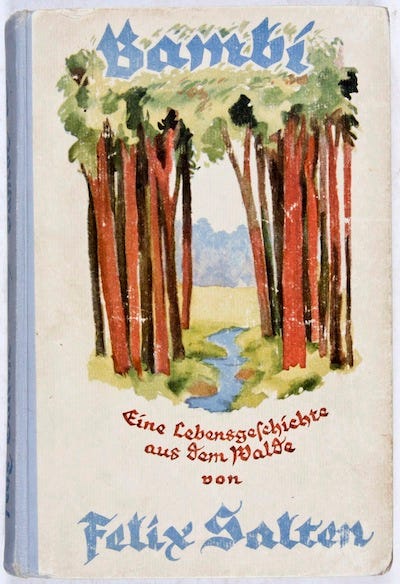
The book is dense and devastating. Set in an unknown time in an unknown location, seasons change, babies are born, beloveds die, and time is experienced in broad cycles. Bambi and the deer are presented as demure, ancient creatures who stalk the woods and whose menfolk hold a kind of cosmic knowledge, lonely pilgrims only occasionally seen. The Old Stag, one of the “princes,” the most rabbinical of these lonely men, visits Bambi throughout the book offering bits of cryptic wisdom, giving us the sense that Bambi himself is destined for greatness. Turns out the Old Stag is Bambi’s dad and eventually passes on his sombre responsibilities of saying cryptic things to young boys to his son. But, for my money, the most interesting young deer in the book is a fella named Gobo.
While you can’t help but admire Bambi’s purity of heart and noble pedigree, Gobo stands in for the rest of us: impulsive, irrational, emotional, yearning, naive. He sees the good in the forest, prances about with impunity, and doesn’t really understand why everyone is so uptight about these damn old men who don’t even come around that much anyway. I don’t think Salten really wants us to like Gobo, but the haunting trajectory of his story resonates in a wild way considering Salten’s background (more on that.) Bambi’s mom famously gets gunned down by Lacanian-Big-H “Him” (Man), but the hunting trip massacre that leads to her death also includes young Gobo, Bambi’s best friend and contemporary, being shot and dragged away, presumed dead. Turns out there is a fate worse.
Many seasons after Gobo disappears, he returns to his people an unrecognizable buck. We learn that He kept Gobo as a pet, nursed him on hay and corn, and kept him amongst cows, sheep, pigs, and dogs. As such, Gobo no longer fears Him and comes off real smarmy when asked if he was afraid for his life in His clutches:
“Gobo gave a superior smile. ‘No, my dear Faline [his sister, Bambi’s wife]. Not at all. I knew He didn’t want to hurt me. Why would I be scared? You all think He’s wicked, but He’s not wicked—when He likes someone, when someone serves Him, He is good. Nice and good. No one in the whole world is as good as Him…’
Suddenly, as Gobo was saying this, the Old Stag stepped noiselessly out of the undergrowth. Gobo didn’t notice and kept talking.
No manners ass!!
But everyone else had seen the Old Stag and reverently held their breath.
The Old Stag stood without moving, watching Gobo with is deep, serious eyes. Gobo said: ‘It wasn’t just Him, His children loved me too, His wife, everyone. They petted me, gave me food, played with me…’ He broke off. He had just seen the Old Stag.

Silence fell.
Then the Old Stag, in his calm, commanding voice, asked, ‘What’s that stripe on your neck?’
Everyone looked and noticed for the first time the dark ring around Gobo’s neck where his fur had been pressed down and worn completely away.
Gobo answered uncertainly: ‘That?…That’s from the collar I wore… His collar… and… yes… it’s a great honor, the greatest honor, to wear His collar… it’s….’ Confused, he stammered to a halt.
Everyone was silent. The Old Stag looked at Gobo for a long time; a penetrating, melancholy look.
‘Sad,’ he said softly, then turned and was gone.”
Withering!
I find Gobo’s domestication complex and heartbreaking. Gobo is optimistic and trusting, which grants him access to a kind of privileged, lived knowledge of both His cruelty (from being on the wrong end of the gun) and His benevolence (from being a recipient of care afterwards.) Gobo understands His power and seems to naturally acknowledge a desire for proximity to it, which represents safety from the violence of the hunt—He kills the deer of the woods, not the deer housed in His barnyard. And I get it. When faced with extreme uncertainty about one’s ability to fend off danger, it feels comforting to be in close proximity to those for whom the danger doesn’t exist. But, as Salten reminds us, fleeting proximity does not safety make. By returning to the woods, Gobo is reintegrated into an unsafe class—he could now be any deer, marked by an experience of proximity to Him, but available for harvest/annihilation.
It bears mentioning that the forest to me feels quite Jewish. There is hustle and bustle—a sense of industry—an unflagging anxiety and vigilance towards environmental threat. The animals weave a social fabric that conjures something like a shtetl market—a ghetto—an old dark synagogue—high holidays—the intersection of Wallabout, Lee, and Lorimer. The tapestry is holy in its complexity. The rhythm of old continuously giving way to new feels like mystical intelligence.
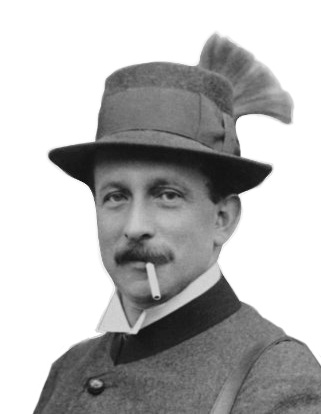
Salten was born Seigmund Salzmann in 1869, the grandson of an orthodox Rabbi. He moved from Pest to Vienna to join the literati (including Schnitzler, incidentally) and make a name as a popular writer. He would have experienced Jews being granted Austrian citizenship and folded into cosmopolitan life. He would have also witnessed the coincidence of his peoples’ general secularization and the slow boil of racialized, antisemitic sentiment. Much like Bambi’s forest, Salten’s Jewish world was one that no doubt felt robust and eternal, as well as under threat from violent actors who you might only perceive after it’s too late. Bambi is an isolationist, adhering strictly to the rules of the Old World, while Gobo is punished for having gotten himself caught up in the New. And, considering that Salten was an fervent early supporter of T. Herzl, it’s not a leap to see how a romantic fantasy of the kibbutz, operating in a state of “nature” outside an unstable European context, plays into how Salten wants us to feel about the good deer who remain dutifully uninvolved with His world.
I can’t say whether or not Bambi is a zionist text. I’m more inclined to read it as Salten tapping into a kind of Jewish unconscious that senses the approach of war—a kind of hesitant acknowledgement that his current moment was in a sense prelapsarian, and that while WWI lingered as a psychological wound in European consciousness, something even more unimaginably dark was around the corner. The creeping, acrid smell of Him… the seductive sense that wearing the collar may negate the fact that one belongs to a hunted species… this feels very in line with the mood of a year that also saw the Beer Hall Putsch. While Salten was a zionist, the book doesn’t read like propaganda necessarily. To me, it granted access to an understanding of how that movement’s imaginary emerged from much the same cultural impulses that drove the Wandervogel, everyone who was into “Das Blaue Licht”-era Leni Riefenstahl, the nascent national socialists, et al: reconnect with nature, and one is promised exemption from the grisly horrors that seem to await everybody else.
Eventually, after his return, Gobo smells Him across the meadow. Naturally, dude is thrilled. The other deer watch in horror as Gobo happily prances out to greet his old master, gleefully impelling them to share in the benefits that come from abandoning their anxious resistance. But, Gobo is now just a deer. Big H He guns him down, no clemency, no stopping to check his papers, no acknowledgement of the ring around his neck. As dispassionately as the Old Stag dismissed him upon his return, the other deer watch with embarrassment and pity as Gobo’s body is dragged away.

It’s easy to dismiss Gobo as brainwashed—a traitor—but I see him as a tragedy of circumstance. He experienced how the system works by offering blissful, paradoxical relief from the anxiety caused by the system itself. And this is why I decided to name this space after the deer tragically (but predictably) left out of the cartoon feature that I have yet to see but will likely always avoid. I say to myself, let’s not be like Gobo. We can so easily go that route and suckle at the teat of the imperial core. But Salten’s doomed anti-prince is a reminder that getting comfortable on the Inside (of the British imperial zionist project, of nationalist/political homogenization, of late capitalist vectorial technocracy, etc) will only ever delay the violence that the system is designed to bring down upon you.
But anyhow:

Read the book!
x